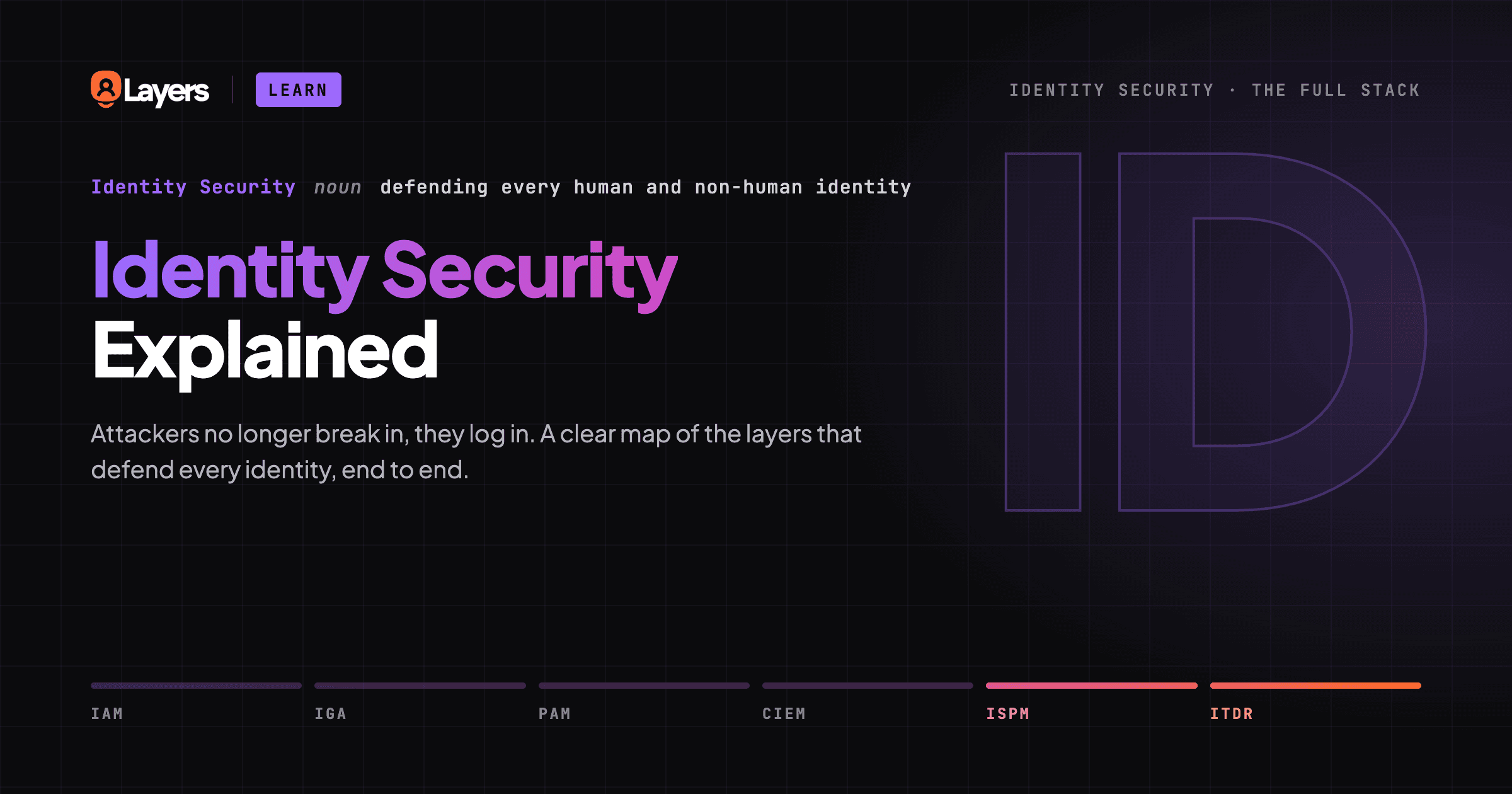
Attackers no longer break in. They log in. As defenses hardened around endpoints and networks, the identity became the easiest way into an organization, and identity security grew from a single product category into a full stack of disciplines. The problem is that the stack is a wall of acronyms, IAM, IGA, PAM, CIEM, ISPM, ITDR, and most explanations treat each in isolation. This guide maps the whole thing, so you can see what each layer does, where it sits, and how they fit together.
What is identity security?
Identity security is the practice of protecting every identity in an organization, human and non-human, across its entire lifecycle: granting the right access, keeping that access safe, reducing the risk it carries, and detecting and stopping attacks that target it. It is not one tool. It is a stack of connected disciplines that together cover who gets access, how that access is governed, how exposed it is, and whether it is being abused right now.
The reason it matters is simple. Once an attacker holds a valid credential, the traditional perimeter is already behind them. Identity has become the control plane, and securing it end to end is now the core of enterprise defense.
The identity security stack, layer by layer
Think of the stack in two halves. The first half is about granting and governing access. The second half is about reducing risk and defending against attacks. Here is how the pieces line up.
IAM: authenticate and grant access
Identity and Access Management is the foundation. It authenticates identities and controls what they can access, through single sign-on, multi-factor authentication, and access policies. IAM answers the most basic question: is this identity who it claims to be, and is it allowed in?
IGA: govern the lifecycle of access
Identity Governance and Administration manages digital identities and their access throughout the enterprise. It provisions access when someone joins or changes roles, runs access requests and approvals, enforces separation of duties, and conducts the periodic reviews and attestations that auditors expect. IGA answers: who should have access to what, and can we prove it was approved? For the full breakdown, see IGA Explained.
PAM: control privileged access
Privileged Access Management secures and monitors the most powerful accounts, the admin and root credentials that can do the most damage if abused. It controls how privileged access is granted, often just in time, and records what is done with it.
CIEM: manage cloud entitlements
Cloud Infrastructure Entitlement Management is a cloud security discipline for managing identities and privileges across cloud environments. It discovers who can access what in AWS, Azure, and Google Cloud, finds excessive and unused permissions, and drives least privilege across constantly changing cloud entitlements. For more, see CIEM Explained.
ISPM: reduce the identity attack surface
Identity Security Posture Management continuously measures how risky your identities are right now and reduces that exposure before an attacker finds it. It discovers every identity across every provider, scores each against security baselines, and prioritizes what to fix. ISPM answers: what is our identity attack surface, and how do we shrink it? For the foundation, see identity security posture management.
ITDR: detect and respond to attacks
Identity Threat Detection and Response is the real-time layer. It watches authentication, session, and privilege activity and steps in when an identity is under attack, giving analysts the investigation and response actions to contain it. ITDR answers: is an identity attack happening right now? For more, see What Is ITDR Security.

How the layers fit together
The stack is not a menu of alternatives. It is a sequence that covers an identity from the moment it is created to the moment it is attacked.
IAM lets an identity in. IGA governs what it should be allowed to do and proves it was approved. PAM locks down its most dangerous privileges. CIEM keeps its cloud entitlements at least privilege. ISPM continuously measures and reduces the risk the whole picture represents. ITDR catches any attack that still gets through. Each layer hands context to the next, and gaps open wherever two layers do not share data.
The most common failure is treating these as six disconnected purchases. Governance grants access that posture never re-evaluates. Posture flags a risk that detection never hears about. Detection fires an alert with no idea the identity was already high risk. The value of the stack comes from the layers working on shared context, not from owning all six logos.
Where posture, detection, and compliance converge
The clearest convergence in the stack is between ISPM, ITDR, and continuous compliance. When posture scores an identity as high risk, detection should weigh that the moment the identity behaves strangely. When detection catches an attack, posture should re-harden what let it through. And when either finds a problem, compliance should already know which controls it touches.
That feedback loop is what disconnected tools cannot produce, and it is how the 8Layers platform is built. Octagon delivers ISPM, Thor delivers ITDR, and Compass delivers continuous compliance, all on one shared identity data layer so a finding in one arrives with context from the others.
If you want to see how the layers work together against your own environment, request a demo.
Frequently asked questions
What is identity security?
Identity security is the practice of protecting every identity, human and non-human, across its lifecycle: granting the right access, governing it, reducing the risk it carries, and detecting and stopping attacks that target it. It is a stack of connected disciplines, not a single product.
What are the layers of the identity security stack?
The main layers are IAM (authenticate and grant access), IGA (govern the access lifecycle), PAM (control privileged access), CIEM (manage cloud entitlements), ISPM (reduce the identity attack surface), and ITDR (detect and respond to identity attacks). Together they cover an identity from creation to attack.
Why is identity security so important now?
Because attackers increasingly use valid credentials rather than malware. Once a credential is stolen, endpoint and network defenses are already bypassed, so identity has become the control plane and the primary surface to defend.
Do I need every layer of the stack?
Most mature programs use all of them, but the priority depends on your environment. The bigger point is that the layers lose value in isolation: the stack works best when posture, detection, and compliance in particular share one identity data layer so each informs the others.
About the author
Product Marketing Manager, 8Layers
Over a decade in product marketing, go-to-market, and product launches across B2B SaaS environments. Always tracking where the Identity Security space is heading. Focused on translating what's next into what the business does today.