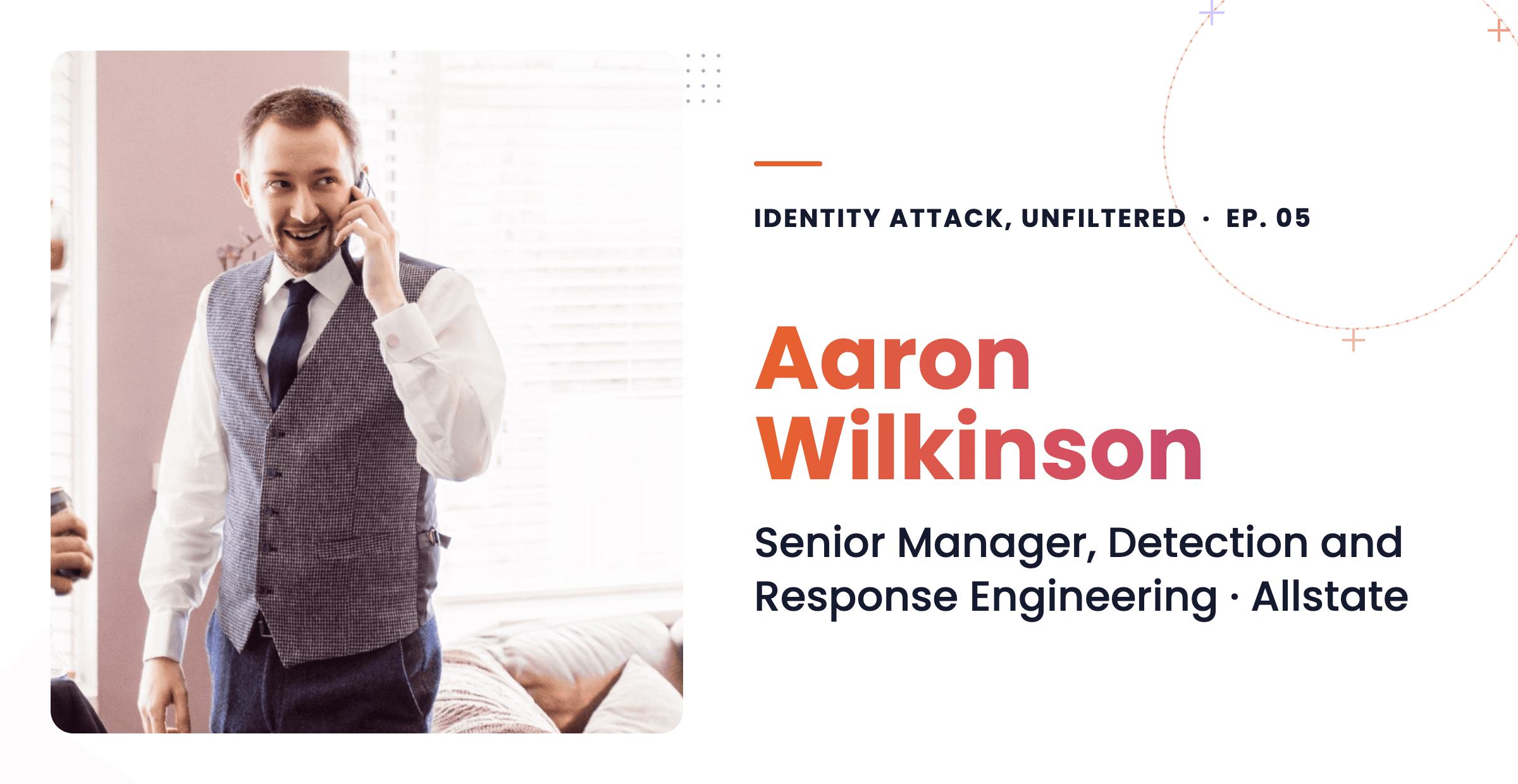
Aaron Wilkinson is a three-time world champion at OSINT (open-source intelligence), the craft of piecing together everything about a target from data that’s already public: social media, photos, leaks, forums. So when we asked him how much that public data really feeds identity attacks today, his answer was one word short of a warning: “a disgusting amount.”
Nowadays, he leads Detection and Response Engineering at Allstate, after a path that runs from a cybersecurity internship at CME Group through incident response leadership at Orbia, building a CIRT from the ground up. And - something clearly close to his heart - he helps train the next generation of incident responders as a university module author.
As usual on Identity Attack, Unfiltered, we talked about why identity and why it is so hard to detect; however, the conversation was good enough that, toward the end, we happily drifted a little beyond identity itself. What follows are his answers, unfiltered.
8Layers: You lead Detection and Response at a global scale. From a detection engineering standpoint, is identity-based attack activity harder to detect than traditional malware or exploitation? Why?
Aaron: For sure we are entering an era where the detection of identity-based attacks is materially more difficult than endpoint based threats. We have grown used to identifying IOC-based threats (hashes, filenames, paths) and even detection of runtime + behavioral-based threats on an endpoint. Identity is still a relatively new frontier in the grand scheme of D+R, especially as we have an ever growing reliance on SaaS to perform job responsibilities. Identity artifacts can be indistinguishable from legitimate artifacting too; authentication is the same, tokens are valid, API calls are well formed. Improved behavioural analytics in the identity domain will help us to tackle these threats in the near and long term!
8L: When an attacker is “living off the land” with legitimate stolen credentials, what are the behavioural signals or detection strategies that actually work to separate them from a real user? Where do defenders still have blind spots?
Aaron: Great question and honestly, difficult to answer as it varies from organisation to organisation. Session-level behavioural analytics become critical here - Impossible Travel and Anomalous Session Alerting are table stakes. Risk-Based Alerting (RBA) that derives a high fidelity, highly contextualised alert on a user’s account becomes the norm for identity-based threats, for example: registration of a new MFA device, or granting OAuth consent to an unknown application, followed by an increase in performed operations or access to rare files/folders within X period of time, becomes a great indicator for detecting suspicious/malicious attacks occurring at the identity level. It’s not enough to just feed endpoint telemetry anymore - the conversation has shifted to protection of the identity + cloud layer.
8L: As a 3-time OSINT CTF World Champion, you know better than most how much can be pieced together from public data. How much does open-source intelligence realistically contribute to identity attacks today, and how underestimated is it as a threat?
Aaron: What an excellent question, and my honest / blunt answer is: a disgusting amount. Attacks can frequently begin by trawling personal social media accounts, crafting a spear phishing email that enables attackers to steal active sessions, device code phishing, and much more. It’s critically important to be aware of your digital footprint and take measured steps to removing your data where possible, especially from social media. This is incredibly underestimated, as it’s nearly impossible to detect this at the reconnaissance phase. Our first detection occurs when we see that login attempt against your account, from an IP close to your home.
8L: Detection as Code and automation are clearly close to your heart. How do you see automation and AI changing the game for defending against identity attacks, both the opportunities and the risks of over-relying on them?
Aaron: The critical juncture we are currently at is that, irrespective of how prepared your organisation is for the world of agentic-driven threats, we will have to move much faster and provide more context than ever before to ensure our organisations have sufficient capability to detect and respond to cyber threats. Automation and AI are no longer optional. Detection-as-code and CI/CD pipelines are no longer optional. Scale, speed, consistency and enrichment are mandatory as we undergo the transformation to respond to machine-speed threats in future.
8L: After years of responding to incidents, is there a case involving identity or credential abuse that genuinely changed the way you think about the problem?
Aaron: The one that reframed it for me involved no exploit, and no malware. Every technical control performed exactly as designed. The attacker simply persuaded a human to hand over a reset credential, and from that moment every subsequent action was marked as legitimate by default. What changed was where we look for ‘bad’. I had been treating authentication as the perimeter, but it isn’t; the identity lifecycle is: enrolment, reset, recovery, delegation and de-provisioning. Those are the moments where trust is actually created, and in most organisations they are the least instrumented, or most legacy processes we own.
8L: Looking ahead: what identity or detection challenge do you think will define the next 2–3 years, and that most teams are dangerously unprepared for?
Aaron: Opportunities to detect identity-based threats at the cloud/SaaS layer are going to be critical for us to learn and grow as Detection and Response analysts. With the ever increasing shift into over reliance on SaaS-based vendors, third-party supplier / risk management processes will need to be secured even further. Procurement steps will need to be bolstered with security in mind. Logging and auditing must be a requirement in every technological evaluation across IT and security, ensuring that the next frontier of identity-based threats can not only be detected in real time, but also automatically responded to by expert analysts, or autonomous agentic systems.
8L: Stepping back from identity for a moment: you’re helping train the next generation of incident responders. What’s the one thing about the field that you wish more junior analysts understood from day one?
Aaron: Be curious and question everything: people, process and technologies. You gain the most knowledge by trial and error, asking questions and constantly changing your perspective on what ‘good’ is / should be. Our industry evolves faster than most, and being at the cutting edge will ensure that you are set up for a long, successful career within Detection and Response.
If anything stays from this conversation with Aaron, it’s where he tells us to stop looking (login/authentication). The identity lifecycle is: enrollment, reset, recovery, delegation, de-provisioning. Those quiet, often legacy moments are where trust is actually created. Add to that how much an attack is pieced together from data we hand over freely in public, and the picture is uncomfortable but clear: the hardest part of defending identity isn’t the exploit, it’s everything that looks perfectly normal.
Identity Attack, Unfiltered
Identity Attack, Unfiltered is 8Layers’ biweekly series where we give security experts the floor to talk, unfiltered, about identity risk: how they see it from the field, what worries them, and what they’d do differently. Each conversation adds a different perspective, from governance to digital forensics, from the SOC to threat intelligence.
The series grows out of what we do at 8Layers: uniting in a single view of identity what normally lives apart: posture, detection, and compliance.
Do you work in identity security and feel you have something to contribute? We’d love to hear from you. Write to us at marketing@8layers.io and tell us your perspective; you could be the next voice in the series.